
Home / Our work
Policy & legal engagement
Cancer Policy Lab
An innovation of the Ananda Centre for Cancer Research that translates research evidence into policy and action.
What is the Cancer Policy Lab?
A bridge between research and policy
The Cancer Policy Lab (CPL) is a structured, multi-sector platform that brings together policymakers, researchers, clinicians and partners to address real-world cancer policy challenges.
It focuses on priority policy questions and uses a clear process, turning evidence into informed deliberation and deliberation into practical policy recommendations that can shape national and regional cancer policies.
Why it matters
- Supports evidence-informed policymaking. Decisions are guided by the best available research and data.
- Strengthens cancer control. Helps develop strategies that effectively reduce the cancer burden in Uganda.
- Promotes equity. All populations, including vulnerable groups, have access to prevention and care.
- Builds capacity. Enhances the skills and knowledge of stakeholders involved in cancer control and policy development.
How it works
Evidence, then deliberation, then policy action
The Lab applies a structured evidence-to-policy model to priority cancer challenges.
Define the policy question
Identify a critical national cancer policy challenge, such as HPV vaccination prioritisation, in partnership with government and stakeholders.
Synthesise evidence
Compile global and local data, including research and modelling, to assess impact, cost-effectiveness and policy options.
Convene multi-sector stakeholders
Bring together policymakers, clinicians, researchers, civil society and partners to deliberate on policy, financing, equity and health systems.
Deliver actionable recommendations
Generate clear, evidence-informed recommendations with practical pathways for implementation, scale-up and accountability.
The model ensures that policy decisions are grounded in evidence, shaped by stakeholders and designed for real-world impact.
Cancer Policy Lab Uganda, 2026
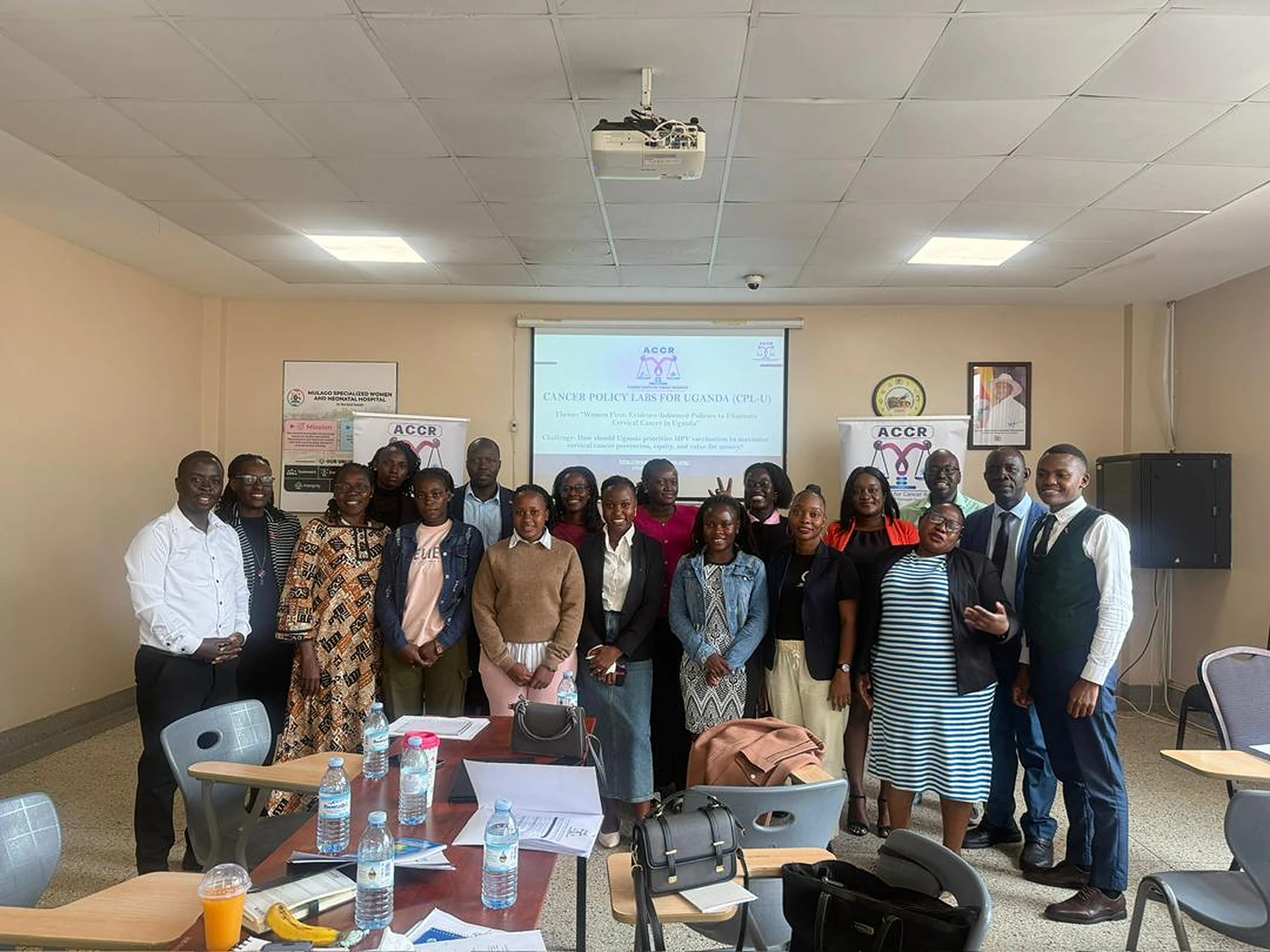
The inaugural Lab: HPV vaccination
The inaugural Cancer Policy Lab Uganda (CPL-U) was convened in 2026 as a multi-sector platform to address a critical national cancer policy challenge. It generated policy recommendations to improve the coverage, equity and sustainability of HPV vaccination in Uganda.
The convening demonstrated the power of structured, multi-stakeholder engagement in shaping practical, evidence-driven cancer policy.
- Theme
- Accelerating cervical cancer elimination through evidence-informed HPV vaccination
- Date
- 7 March 2026
- Participants
- Policymakers, clinicians, researchers, civil society and key national and global partners
- Key focus
- Evidence-based recommendations to optimise HPV vaccination prioritisation, focusing on girls aged 9–14 years, with efficient catch-up vaccination up to 20 years
Invest in evidence-driven cancer policy
Following the success of Cancer Policy Lab Uganda in advancing HPV vaccination policy, we are seeking strategic funding to scale this proven model across priority cancer areas and regions. Partner with us to turn evidence into policy, and policy into lives saved.